Preprint · 2026

StereoViT

Stereo Vision Transformer for
Robust Robot Manipulation

1ETH Zurich 2Max Planck Institute for Informatics, Saarland Informatics Campus 3Microsoft 4KE:SAI
Same model, frozen: diffusion policies on StereoViT features, in unseen scenes · 2×
Live 3D · StereoViT-L point cloud from one stereo pair · drag to look around
#1
on five stereo benchmarks, one checkpoint
1.5–4.8×
faster than high-accuracy stereo models
1.7×
next best policy under domain randomization (RoboTwin 2.0)
57.5%
real-robot success in unseen scenes (next best 34.2%)

Overview video

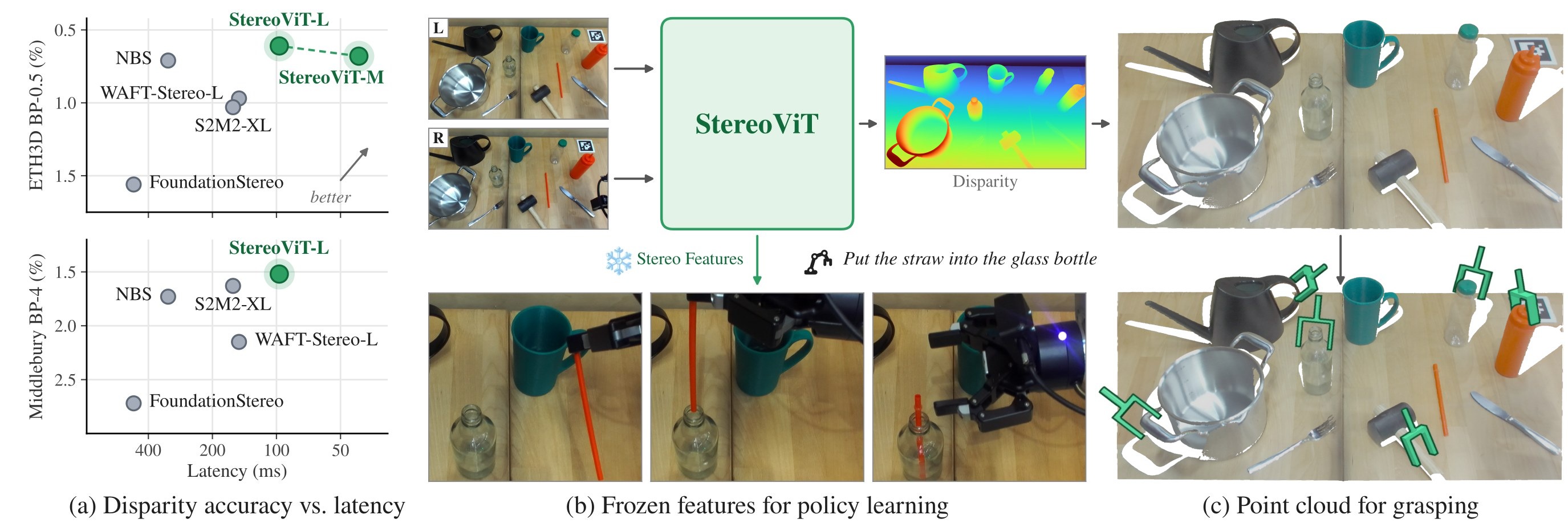
StereoViT overview: accuracy vs latency, frozen features for policy learning, point cloud for grasping
Accurate, fast, and transferable to robust robot manipulation. Hover a panel to try it; click to open its section.
AbstractRead the abstract

Stereo cameras give robots metric geometry from passive, cheap sensors, and stereo input has been shown to improve manipulation policies over monocular RGB. Yet unlike monocular vision, stereo lacks a widely adopted feature backbone for robot learning: leading stereo models rely on cost volumes, feature warping, and iterative refinement, so their geometry emerges over many refinement steps, leaving intermediate features less suited for direct reuse. Inspired by recent evidence that these inductive biases are not strictly necessary for accuracy, we present StereoViT, a streamlined stereo vision transformer that provides both accurate disparity and transferable stereo features for robotic manipulation. StereoViT first uses a depth-pretrained ViT to encode each view, and then a transformer decoder to relate the stereo pair with attentions, predicting disparity in a single feed-forward pass. With one checkpoint, StereoViT ranks first on KITTI 2012 and 2015 (all metrics), ETH3D (BP-0.5), Middlebury (BP-4), and Spring (all metrics) and is 1.5–4.8× faster than competing methods. Its depth yields the highest grasp success among stereo methods, while its frozen stereo features match the strongest diffusion policy baselines in clean scenes and achieve much higher success rates under domain randomization on the RoboTwin 2.0 benchmark. Real-world experiments further confirm these gains.

MethodNo cost volume. No iterations. One forward pass.

A transformer relates the two views directly. The same features give disparity and drive robot policies.

Depth-pretrained encoder

A shared ViT from Depth Anything V2 encodes each view.

Cross-view decoder

Windowed and global attention relate the two views.

Expectation head

Disparity as an expectation over fixed anchors.

Frozen features for policies

Frozen decoder features condition a diffusion policy.

AccuracyTop of the leaderboards, at a fraction of the latency

Ranked first on five benchmarks with a single checkpoint.

#1 KITTI 2012 #1 KITTI 2015 #1 ETH3D BP-0.5 #1 Middlebury BP-4 #1 Spring

Official test leaderboards. Latency at 544×960, one GH200 (FP32). Hover for numbers.

InteractiveMetric 3D from a single stereo pair

One stereo pair, one forward pass. No fusion over time.

Tabletop
drag orbit · scroll zoom · right-drag pan · middle-drag roll
Left input image StereoViT disparity
Left imageDisparity

Disparity comparisonHard cases: glass, metal and fine detail

Drag the handle to compare StereoViT's disparity with state-of-the-art stereo models, or with the ground truth.

Compare with
Baseline disparity StereoViT disparity
FoundationStereoStereoViT

Input image
Input

Disparity, near = red, far = blue; one colour scale per scene, set by the ground truth. White = no ground truth.

Real robotTrained in one scene. Deployed in unseen ones.

Frozen StereoViT features, a policy trained in one scene, tested in new ones. Videos at 2×.

Pour Glass

Training scene
Training scene
2×Unseen scene
StereoViT (ours)

Success over 20 rollouts per policy.

Mean success over six tasks

Depth in the robot's workspace

Top camera of the robot, in the training scenes. Drag the handle to compare StereoViT's depth with the ZED camera's own depth and with stereo baselines.

Compare with
Baseline depth StereoViT depth
ZED depthStereoViT

Left camera image
Left image

Depth, shown as inverse depth (near = red, far = blue) with one colour scale per scene. The stereo models' disparity is converted to depth with the stereo baseline fitted to the sensor depth. Black = no sensor depth.

Also in the paperGrasping and simulation

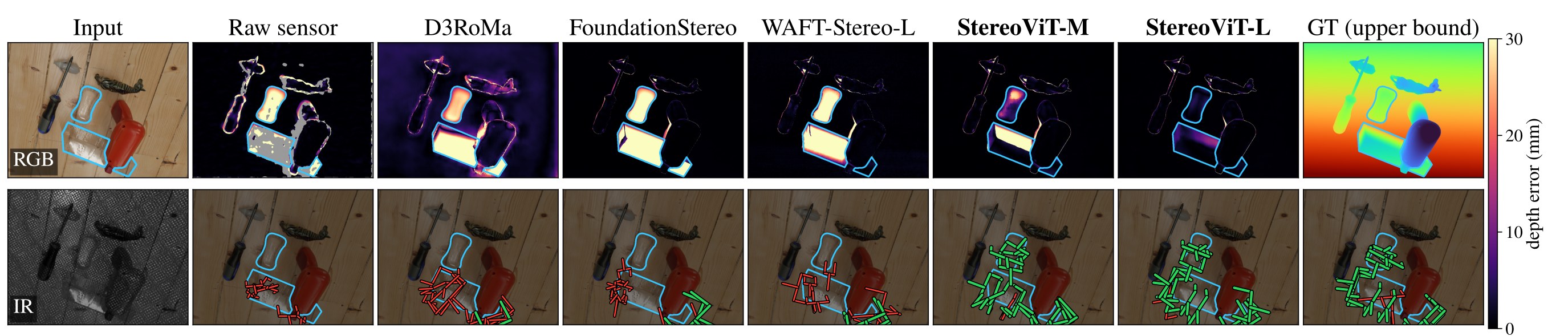
Grasping on DREDS

Depth for grasping

Highest grasp success among stereo methods on DREDS, especially on transparent objects.

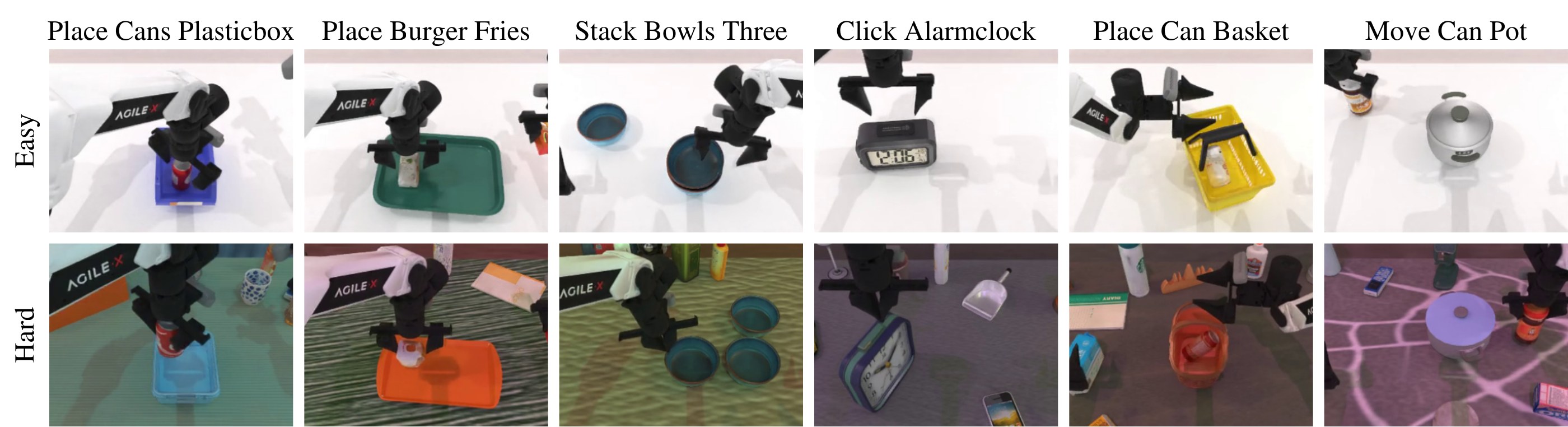
RoboTwin 2.0 tasks

Simulation: RoboTwin 2.0

On par in clean scenes, 1.7× the next best under domain randomization.

CitationBibTeX

@article{zhang2026stereovit,
  title   = {StereoViT: Stereo Vision Transformer for Robust Robot Manipulation},
  author  = {Zhang, Dingxi and Gavryushin, Alexey and Schiele, Bernt and Pollefeys, Marc and Xu, Haofei},
  journal = {arXiv preprint arXiv:XXXX.XXXXX},
  year    = {2026}
}